Yusic
Play music that fits your mood
About
Music brings motivation, joy, memories … all kinds of emotions and adds color to our life amplifying the emotions to create an enhanced experience. This project design brief was to create a music streaming app for relaxation at home. We worked as a team and we were all involved in all the steps of building this concept app.
Teams
Bell Chan, Melody Hung, Xaiver Chan
Duration
2 weeks
UX Techniques
- Interview and Survey
- Affinity Mapping
- Pain Point Analysis
- Persona Creation
- Competitor Analysis
- Paper Prototype (User Testing)
- Wireframes
- Design System
- UI Design & Prototyping
The Process
Following the Human-Centered Design Thinking process, the design decisions were supported by user reseach and feedback.

Empathize with users
Discover user pain-points.

Define the problem
Synthesizing research findings through Affinity Map.

Ideate to find possible solutions
Define the solution to tackle those pain points.

Prototype and test ideas
Iteratively prototype and test concepts with potential users.
Empathize with Users
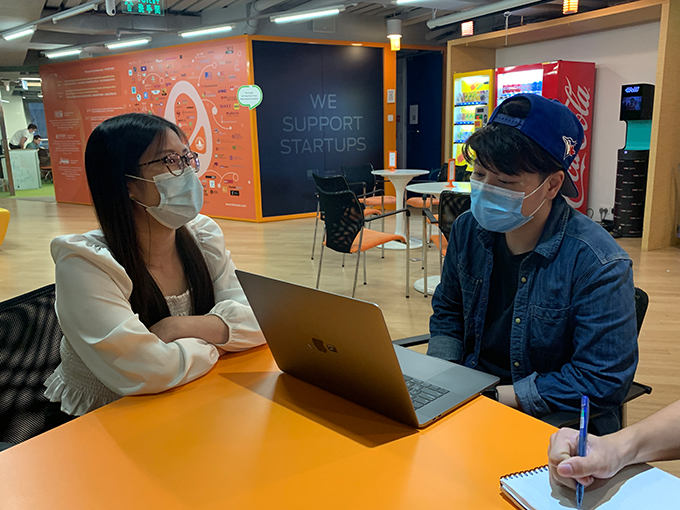
To know who generally our main users are, and what is their general behavior in regard to listening music via music streaming app.
Quantitative Research
We compiled a Google form and distributed it through Discord channels to identify the users. The main focuses of the survey were:
- General behaviour of listening music
- Current usage of music app
- Importance of existing features
Findings from the survey
- 0% said that customized playlist is important
- 0% want an up-to-date music library
- 0% found that music video is not essential at all
- People usually performing two or more tasks simultaneously when they listen to music
Qualitative Research
With those survey results in mind, we discussed together to decide what are the things that we wanted to deep dive more into the user interviews. We interviewed 10 people and did each 3-4 respondents on our own. The topics included but not limited to the following:
- How do people listen to music at home
- How do people feel while listening to music (at home)?
- What do people think about the current music streaming app
Findings from the interview
When I’m home playing music my hands are usually occupied or multitasking, it would be great if I don’t need to always touch my phone to switch songs
Hope that music can auto-play according to time /emotion/ location (Kitchen/Bathroom/Bedroom)
Music changes my mood, gives me a feeling of autonomy & relaxing
Define the Problems
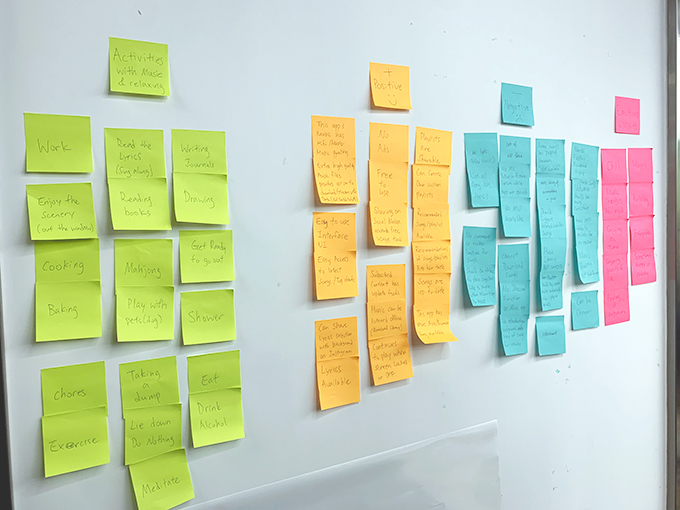
We gathered all the information about the pain points to define the problems. We wrote down the information on sticky notes and put them on wall. Then, we went through all the points and clustered them by topic. We decided to tackle the most important problems which appeared frequently.
Pain Points
Most people who like listening to music prefer to leave their device handsfree. There is an opportunity to help music lovers to enjoy the me time by providing a tool that instantly change playlists that fits the environment & mood.
Problem Statement
How might we provide users a relaxing and personalised music experience?
Personas
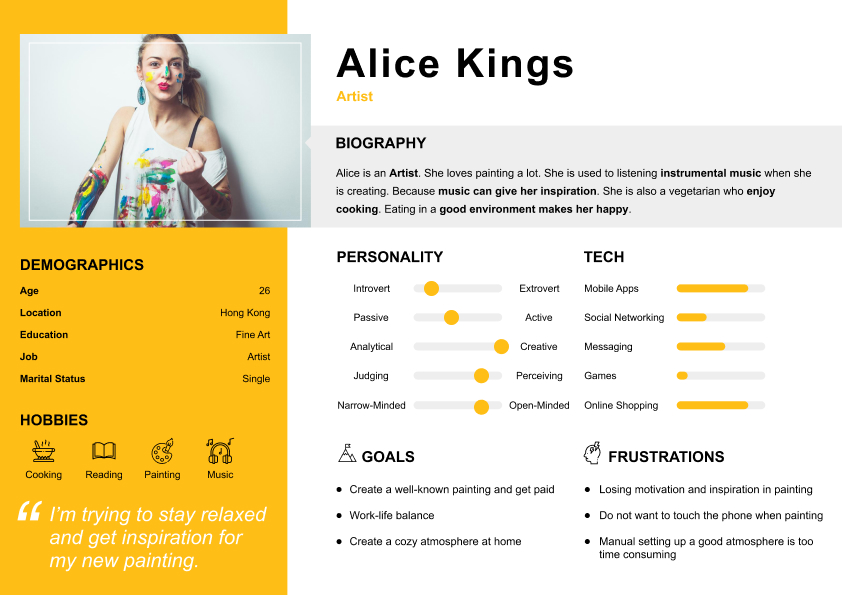
Based on the user research we set up two personas.
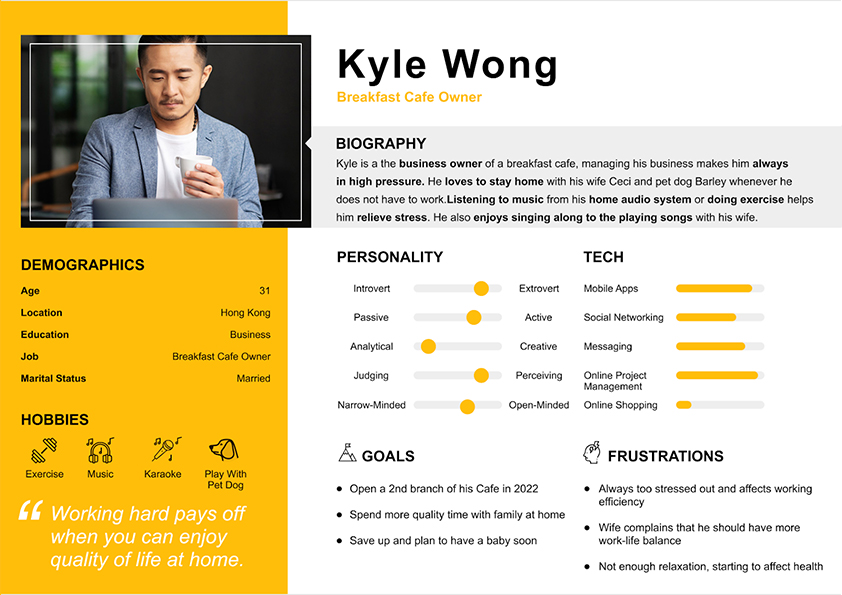
Who is Kyle Wong?
Kyle Wong is a business owner who always in high pressure. Listening to music from his home audio system or doing exercise helps him relieve stress.
Who is Alice Kings?
Alice Kings is an Artist who enjoys listening instrumental music when she is creating becuase music can give her inspiration. She does not want to touch her phone when she is painting. Good environment makes her happy but she found it too time consuming.
Ideate to find possible solutions
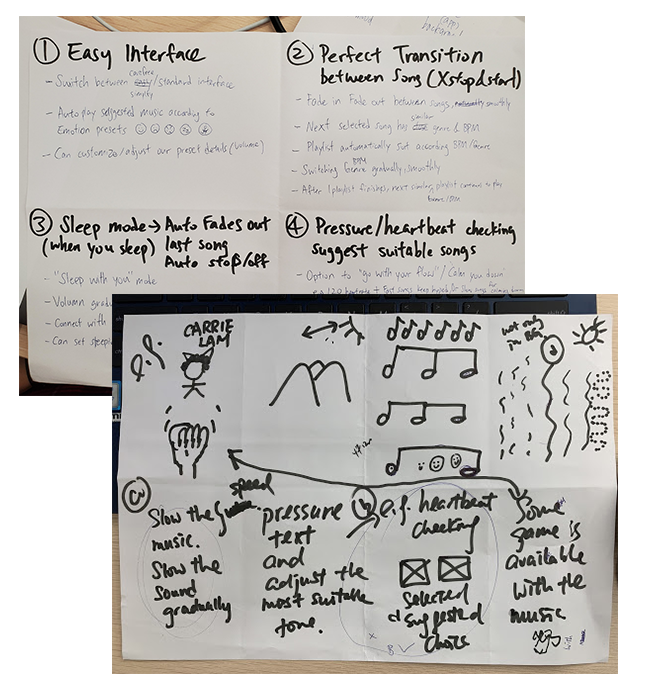
We started by generating 24 ideas individually by doing crazy 8. Then, we brought everyone together to share and voted for the best 4 ideas. After that, we discussed together on the details of the solutions.
Possible Solutions
The features we decided to focus on will add value to the users by providing them:
Voice control
a handsfree music application
Right music for right moment
the app creates an instant playlist that fits the user through an algorithm that capture user’s music taste and favourite songs. It also learns the pattern of use by detecting Stress Level, Time, Weather and Location.
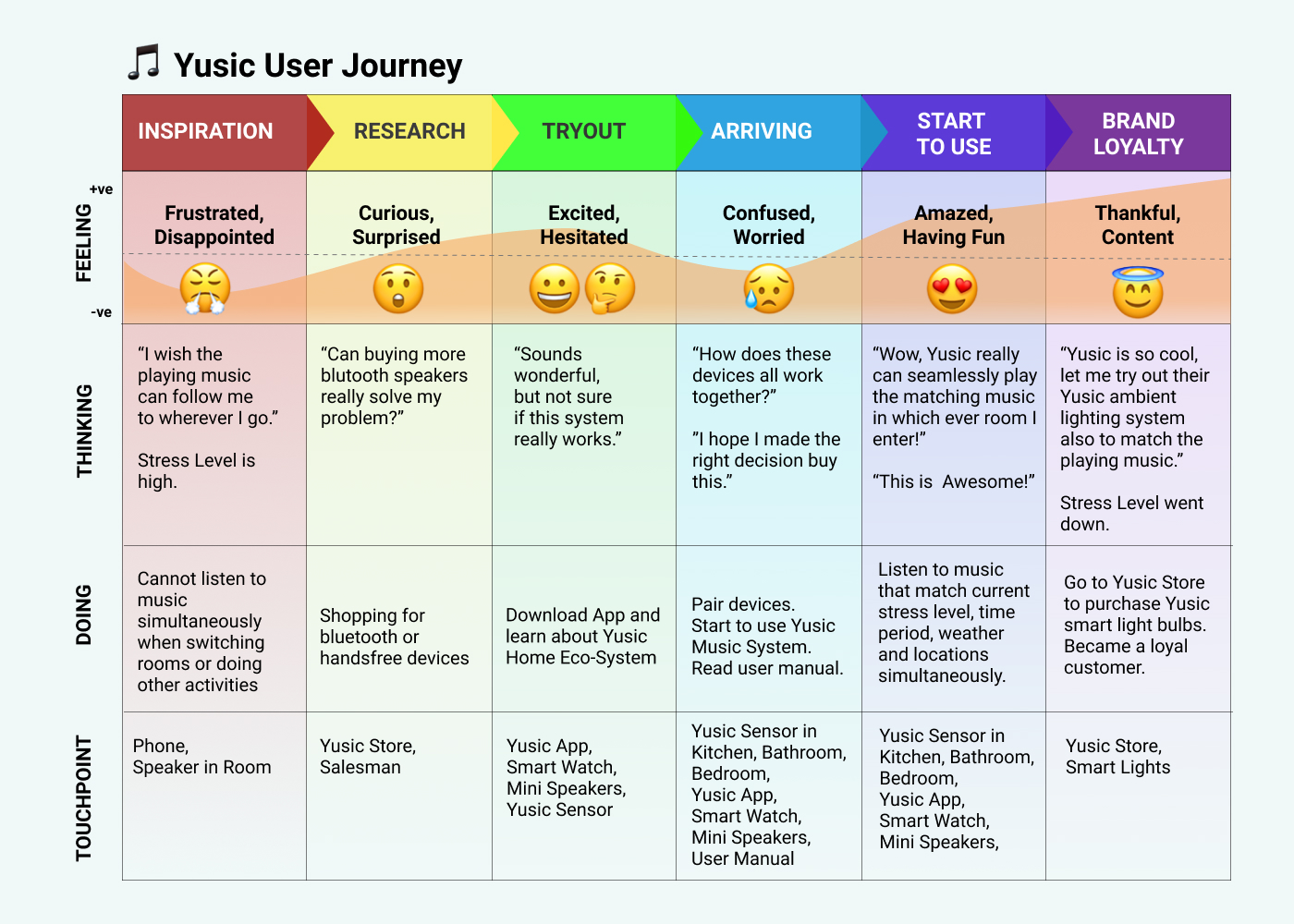
Post Journey Map
We made a sitemap and post-journey map so we could understand better the platform’s structure and the user’s path. The maps also served as a consolidated overview of the app.
Service Blueprint
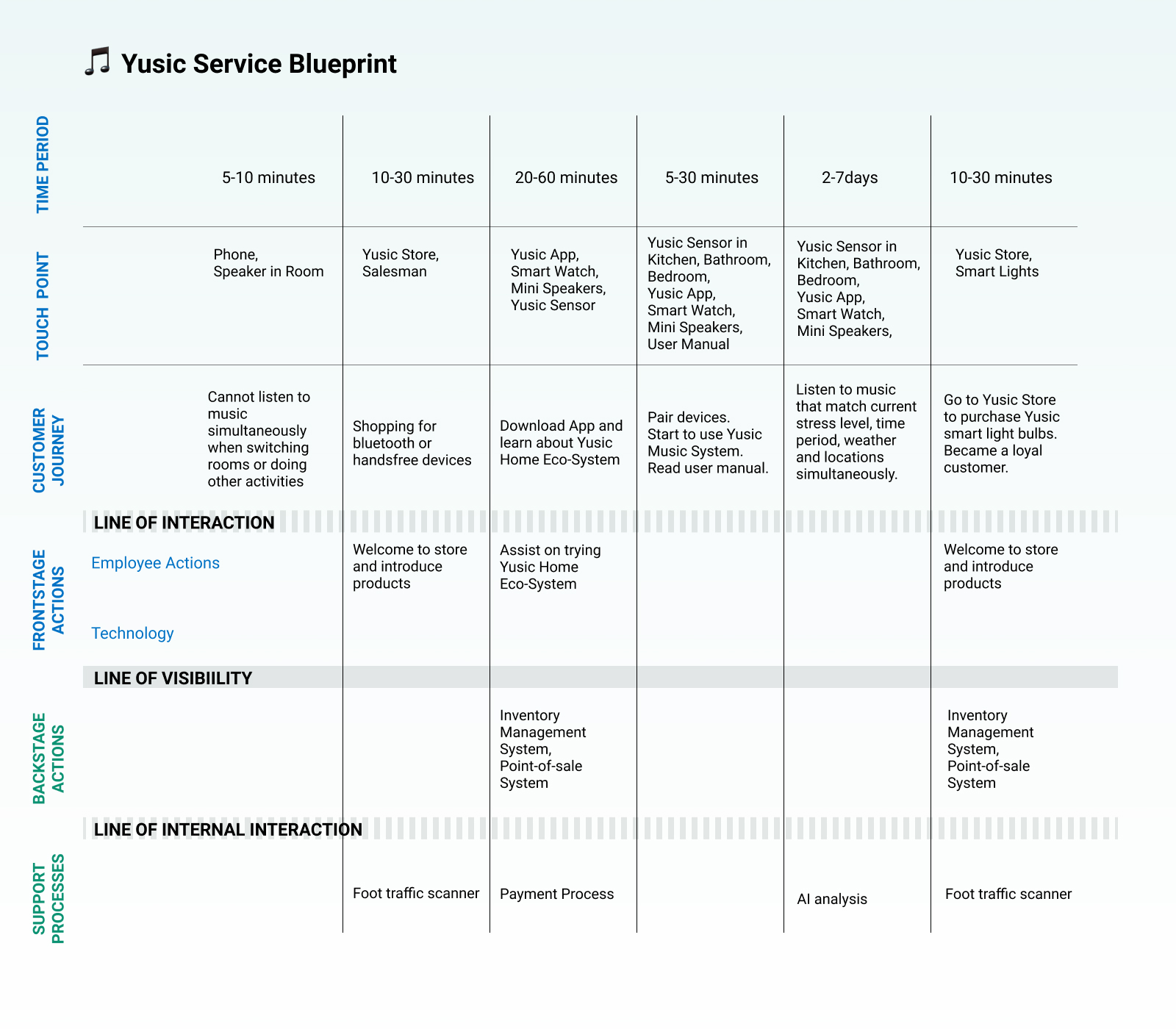
We also made a service blueprint that visualizes the relationships between different service components e.g. people, physic stores, and processes. They are directly tied to touchpoints in the previous customer journey.
Industry Analysis
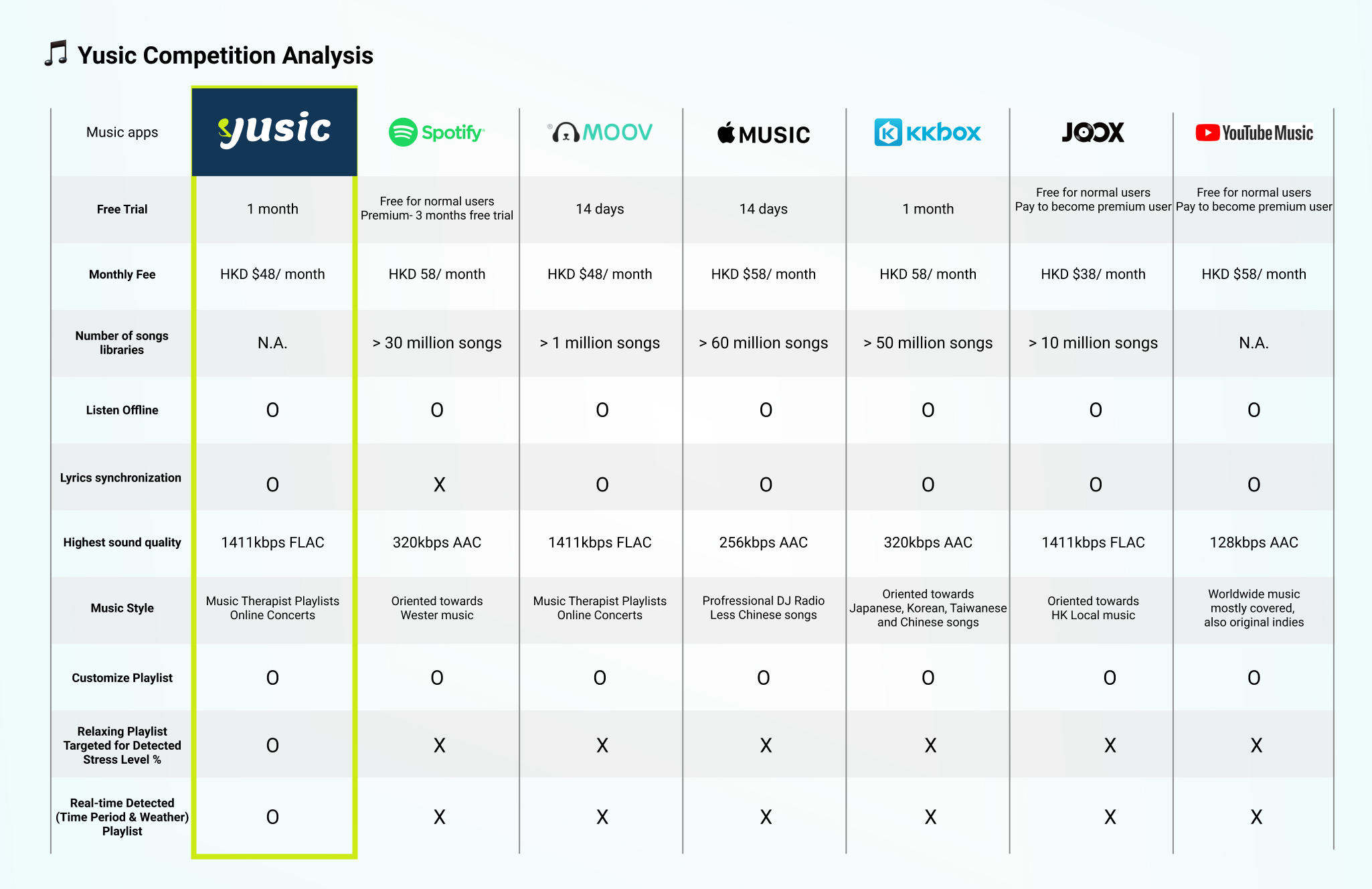
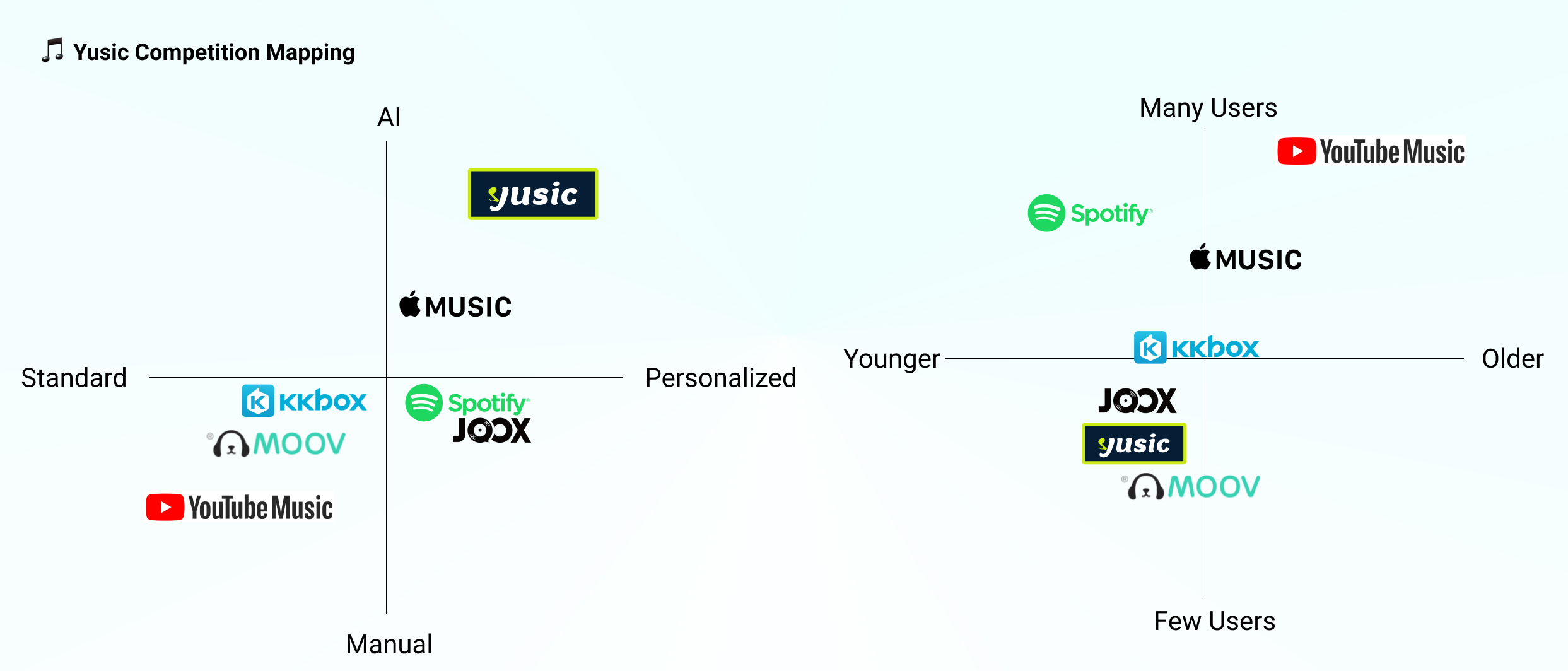
Exploration and deep dive were conducted for companies in the same industry sector who compete with this products and services.
Competitive Analysis
Competitive Mapping
Prototype and Test Idea
Paper Prototype and Testing
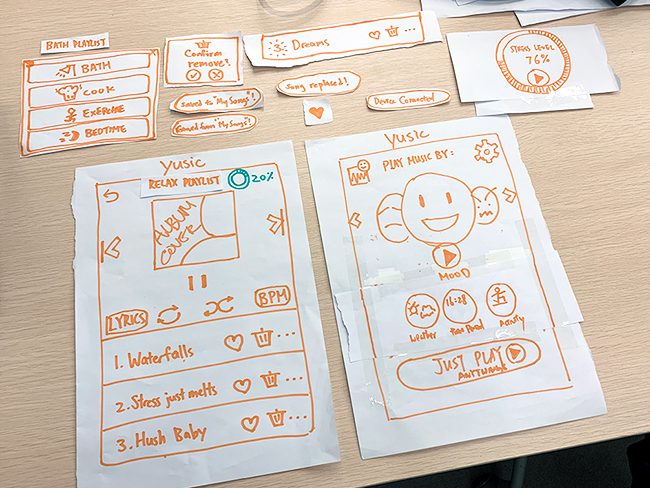
To test our idea on early stage, we made a paper prototype. We had the opportunity to test live in-person during the in-class session. The test was really interesting and we got two feedbacks that gave us good insight to improve the app.
Insight 1
Firstly, there were too many Play buttons on the home screen. The user is confused on which button should be pressed. To simplify it, we decided to combine all the options into a wheel and keep only one Play button.
Insight 2
Secondly, the user thought that the search bar is always necessary even the app is AI-supported because it should always be allowed to choose between using AI or not. Therefore, we decided to add the search function on the top.
Mid-fidelity wireframe
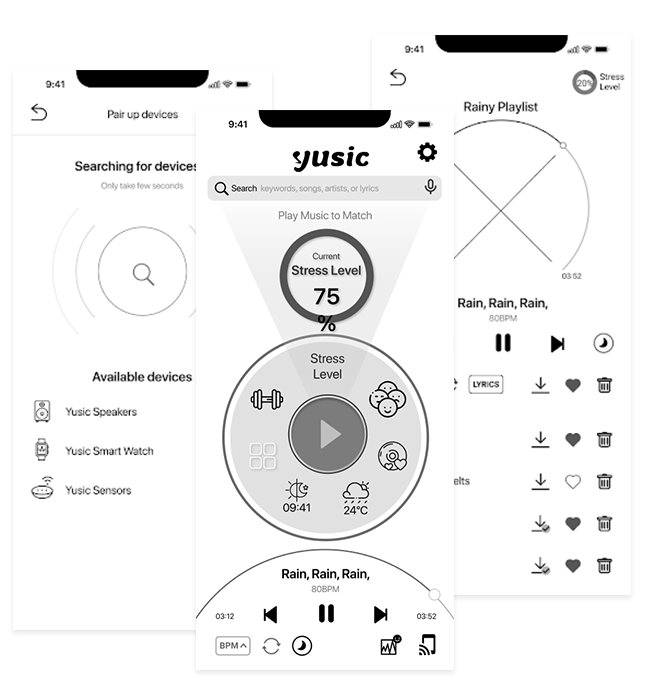
We created mid-fidelity wireframe in Figma after making changes and retesting the paper prototype.
Final User Interface
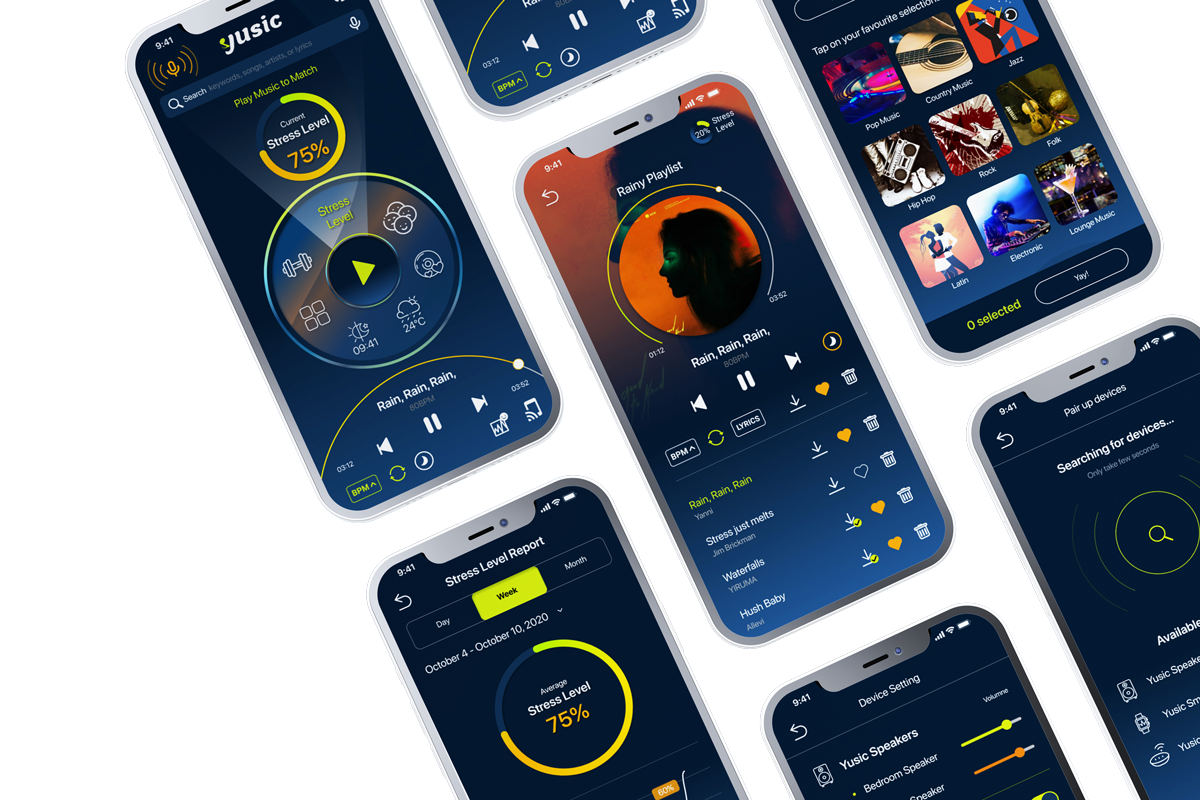
Before creating the final UI, we defined the brand personality as Understanding, Caring, Intelligent, Innovative and Responsive. We made two mood boards and asked the opinions from the users. The design system was created according to the style chose by users.
Conclusion
What I have learned from this project?
I worked on the this project for ten days and had a lot of pleasure working on all stages of the Design Thinking process. I am really proud of this project which had taught me a lot of valuable things:
Research Questions
Creating a good survey/interview questions takes more time than we expected — we needed to find some alternative/indirective questions.
Test on early stage
Testing with paper prototype definitely helped to validate the solutions - we found out what we had missed.
Service Blueprint
Designing the product/service with the help of service blueprint - we discover potential improvements and ways to eliminate redundancy.